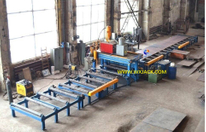
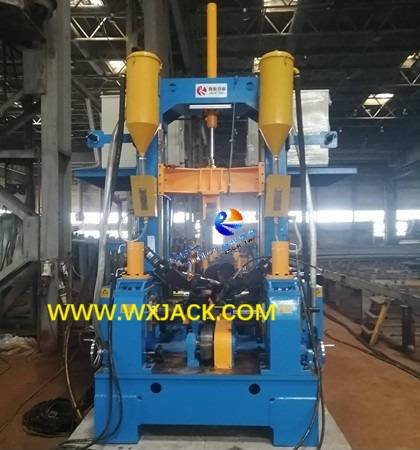
Operation site of Wuxi JACK PHJ20 model machine: (Fig.2)
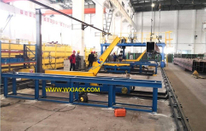
1) Raw Materials: As can be seen from the above photo, there is a heap of raw materials (Long strip steel plates, being cut from CNC Strip Plate Cutting Machine), being cumulated right next to input conveyor roller table of PHJ20. There is also a piece of strip plate on its input conveyor, as flange of H Beam;
2) Machine operating station is at right hand of mechanical main body, as shown in below photo: There is operating panel, and 2 control consoles of SAW welding machine:
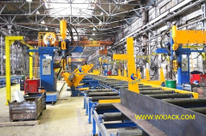
Lateral view on Wuxi JACK PHJ20 model machine: (Fig.3)
3) Operation Way: On the welding machine control consoles, welding current/ voltage/ wire feeding speed can be adjusted, and observed during welding;
3. Supplementary Welding Units of 3 in 1 Vertical H Beam Welding Machine:
These include 2 pieces of each type:
1) Sintered SAW welding flux hose, 100kg capacity hopper and recovery machine;
2) SAW welding wire feeding tube and straightening cell: Diameter Φ2.5mm to Φ4.0mm for single arc, or Φ1.2/ 1.6mm for Twin arc / Tandem arc SAW;
3) SAW welding wire spool;
Being installed on upper U frame of machine mechanical main body;
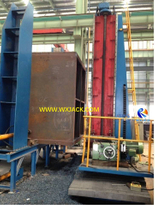
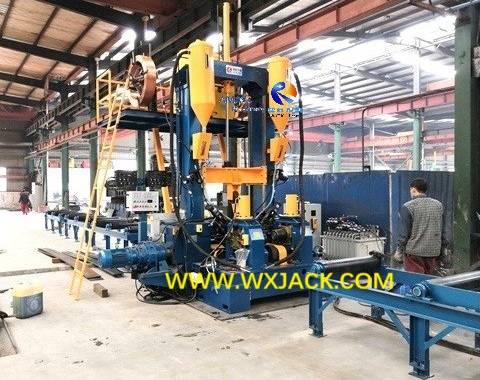
Sometimes customer have their welding wire spool put on the ground, as is shown in below photo: (Fig.4)
4) Function units of machine, including electric control board/ hydraulic pump station/ SAW welding power supplies, are put on workshop ground close to machine main body:
Work site and function units of Wuxi JACK PHJ20 model 3 in 1 Vertical H Beam Welding Machine: (Fig.5)
B. Technical View on PHJ20 Model 3 in 1 H Beam Assembly Welding Straightening Machine:
1. Central Working Zone of 3 in 1 Vertical H Beam Welding Machine:
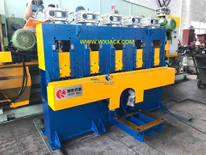
1) Below photo shows machine central function zone. It was taken at H Beam straightening side, outlet; In sequence of installation are assembly/ welding/ straightening units;
2) Central working zone of Wuxi JACK PHJ model machine: (Fig.6)
2. Assembly Unit of PHJ20 Model 3 in 1 H Beam Assembly Welding Straightening Machine:
1) H Beam assembly unit fits up flange and web into “┷” shape (When fabricating T Beam) or “工” (When fabricating I H Beam);
2) Fit up flanges and web are accomplished with totally 6 pairs of eccentric alignment rollers:
a) 3 pairs for clamping web (Higher position rollers);
b) 3 pairs for clamping flange (Lower position rollers);
3) Drive on these alignment rollers is fulfilled with guiding brackets and bushings, which, for flange alignment rollers, the left side is driven with manual leadscrew; The right side is driven with hydraulic cylinders. This is unique assembly mode of PHJ models;
4) Drive way for web alignment rollers are reversed with that of flange alignment rollers;
H Beam assembly alignment rollers of Wuxi JACK PHJ models 3 in 1 Vertical H Beam Welding Machine: (Fig.7)
3. SAW Welding Torches of PHJ Models 3 in 1 Vertical H Beam Welding Machine:
1) The 2 sets of SAW welding torches are execution mechanism for welding operation, which are controlled with SAW power supplies, critical parameters are welding current and voltage;
2) Welding operation is assisted supporting units of flux recovery unit and wire feeder;
3) Position of welding torch can be precisely managed by means of cross slides and 45° gliding bracket, to always aim at welding seam during welding. This is also unique strong point of Wuxi JACK 3 in 1 Vertical H Beam Welding Machine:
4) SAW Welding torches in Wuxi JACK PHJ model machine: (Fig.8)